
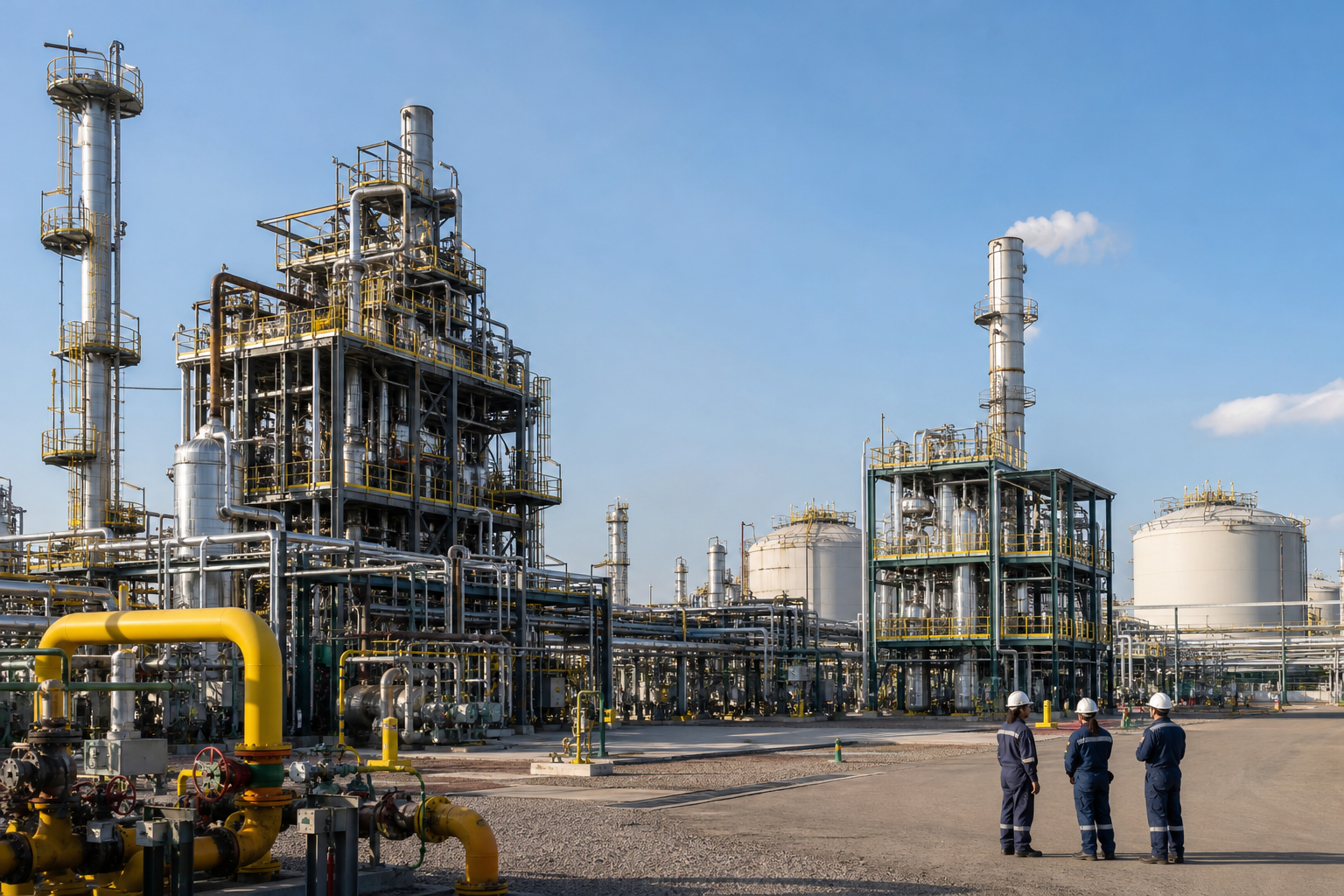
Modular Sulfuric Acid Retrofits for Existing Claus Units

Refiners processing sour crudes have lived with the same basic sulfur decision for decades: build Claus capacity to make elemental sulfur, or build Wet Sulfuric Acid (WSA) capacity to make sulfuric acid. Once that choice is made, it is effectively fixed for the life of the asset, even as markets and sulfur balances move.
Why single-product sulfur strategies limit refinery flexibility
A modular sulfuric acid retrofit adds an acid-production line downstream of an existing Claus unit, allowing the refinery to convert some, none, or all of its Claus-derived sulfur to sulfuric acid. Instead of committing to one product for decades, the plant can follow whichever sulfur or sulfuric acid market offers better value at a given time.
Today, most refineries still frame their sulfur-management strategy around a binary choice between two mature technologies:
- Claus plus tail-gas treating, recovering roughly 95–98% of sulfur as elemental sulfur before tail-gas cleanup.
- WSA, recovering up to about 99.97% of sulfur value directly as concentrated sulfuric acid.
That binary framing ignores how unstable the sulfur–acid relationship has been. Recalibrate’s analysis of 2011–2026 average annual prices shows sulfur trading at a premium to sulfuric acid in most years, but with the premium swinging from nearly zero during the 2020 pandemic downturn to about $160 per tonne during the 2022 Russia–Ukraine energy crisis, and back to an estimated ~$100 per tonne in 2026 amid Middle East disruptions.
On average over fifteen years, sulfur commanded roughly $154 per metric ton versus about $110 for sulfuric acid, a ~$43 per tonne premium. But that average obscures years where prices were nearly equal and years where they diverged by more than triple that gap. A single-product plant is locked onto one side of that spread for decades. A dual-output configuration can capture whichever side is advantaged year by year.
How a modular sulfuric acid line integrates with an existing Claus unit
In the configuration modeled by Recalibrate, the refiner keeps the existing Claus train in place and adds a modular sulfur-burning acid line downstream. The new line converts the refinery’s elemental sulfur into 93–98.5 wt% sulfuric acid, using the same basic SO₂→SO₃→H₂SO₄ route as WSA but without discarding the Claus asset.
Practically, this means the refinery gains three operating modes rather than one:
- Sell all output as elemental sulfur when sulfur premiums are attractive.
- Convert all sulfur to sulfuric acid when acid pricing or local demand improves.
- Blend the two, shifting volumes between sulfur and acid as markets move.
Modularity is as important as chemistry. Instead of one world-scale, single-purpose acid plant sized for a 20-year forecast, capacity is built as standardized lines. A refiner can:
- Commission one active acid line sized to current demand.
- Hold a second line installed but idle for rapid activation.
- Add further lines later as nearby alkylation units, fertilizer complexes, or other acid consumers grow.
Because the add-on acid plant is designed as a complete system—including sulfur-burning, heat recovery, low-emissions design, and an air-separation front end that also produces marketable nitrogen and argon—the refinery is not bolting on an isolated unit. It is adding a configurable sulfur-management platform that can be operated, ramped, and optimized over time.
What the 500 TPD case shows about retrofit vs WSA economics
To quantify the value of this third path, Recalibrate modeled a representative refinery processing about 7 MMSCFD of H₂S—equivalent to roughly 163 TPD of elemental sulfur at full Claus recovery, or about 500 TPD of sulfuric acid if all sulfur value were converted to acid.
Four configurations were compared on new CAPEX, total product revenue, and net energy balance:
-
1. Existing Claus + TGTU only (baseline)
- New CAPEX: $0
- Modeled annual product revenue: $8.79 MM
- Net energy balance: –45.5 MW·yr
-
2. Existing Claus + TGTU + new Recalibrate acid line (retrofit)
- New CAPEX: $100.0 MM
- Modeled annual product revenue: $44.22 MM
- Net energy balance: –355.1 MW·yr
-
3. New WSA plant replacing Claus
- New CAPEX: $134.0 MM
- Modeled annual product revenue: $19.30 MM
- Net energy balance: –393.3 MW·yr
-
4. New Claus + TGTU + new Recalibrate acid line (greenfield)
- New CAPEX: $167.6 MM
- Modeled annual product revenue: $52.51 MM
- Net energy balance: –355.1 MW·yr
Two comparisons matter most for a refiner that already has Claus in the ground:
- Retrofit vs. staying put. Configuration 2 delivers roughly five times the modeled revenue of the Claus-only baseline for a defined, one-time $100 MM outlay, without scrapping the existing unit.
- Retrofit vs. WSA-only. The same $100 MM retrofit produces more than double the modeled revenue of a new-build WSA plant that costs $134 MM—a 34% lower capital requirement for more than twice the return in this case—because the retrofit preserves Claus sulfur revenue and adds acid revenue, rather than replacing one with the other.
The greenfield configuration (4) delivers the highest absolute revenue but is primarily relevant where a refiner is building sulfur-management capacity from scratch.
Operational implications: where modular dual-output designs make sense
The modeled economics do not make Claus-only or WSA-only obsolete. There are clear boundary conditions where each traditional pathway still wins:
- A refinery with firm, long-term sulfuric acid offtake, strong captive acid demand, and substantial internal alkylation load has effectively answered the optionality question in acid’s favor; a dedicated WSA plant may be the simplest answer.
- A refinery with a relatively small H₂S stream, limited capital appetite, and no nearby acid market may reasonably conclude that a well-run Claus + TGTU train remains the right-sized solution.
Where the modular, dual-output approach earns its premium is the middle case that is increasingly common:
- An existing Claus asset already in operation.
- Uncertain future sulfuric acid demand or offtake.
- A desire to keep access to both sulfur and acid markets as the sulfur balance, regional demand, and pricing spreads continue to shift.
In that context, treating sulfur management as a one-time, single-product decision leaves money on the table. Retrofitting an existing Claus unit with modular sulfuric acid capacity allows the refiner to:
- Track a volatile sulfur–acid price spread instead of being fixed on one side of it.
- Stage capital in smaller, standardized increments with shorter payback periods.
- Capture incremental value from nitrogen and argon produced in the air-separation front end.
For technical and commercial teams evaluating sulfur-management strategy, the conclusion from Recalibrate’s 500 TPD case is straightforward: keep the proven Claus asset, add modular acid capacity sized to real demand, and preserve the option to sell sulfur, sulfuric acid, or both for as long as the pricing history suggests that optionality will pay for itself.
The blog can only sketch the key results. The full white paper walks through the underlying stoichiometry, pricing basis, sensitivity analysis, and configuration details in depth, and is the logical next step for teams that want to test these economics against their own H₂S slate, acid demand scenarios, and capital plans.